
Build in public dashboard
for indie hackers
Most build-in-public posts live and die in a single tweet. A real build-in-public dashboard gives your transparency a permanent home — verified MRR pulled from your actual billing stack, not a cropped screenshot from last Thursday. According to Stripe's 2024 Indie Founder Report, 44% of profitable SaaS products are now run by a single founder. The ones building distribution do it through consistent, verifiable public reporting — not one-off launches.
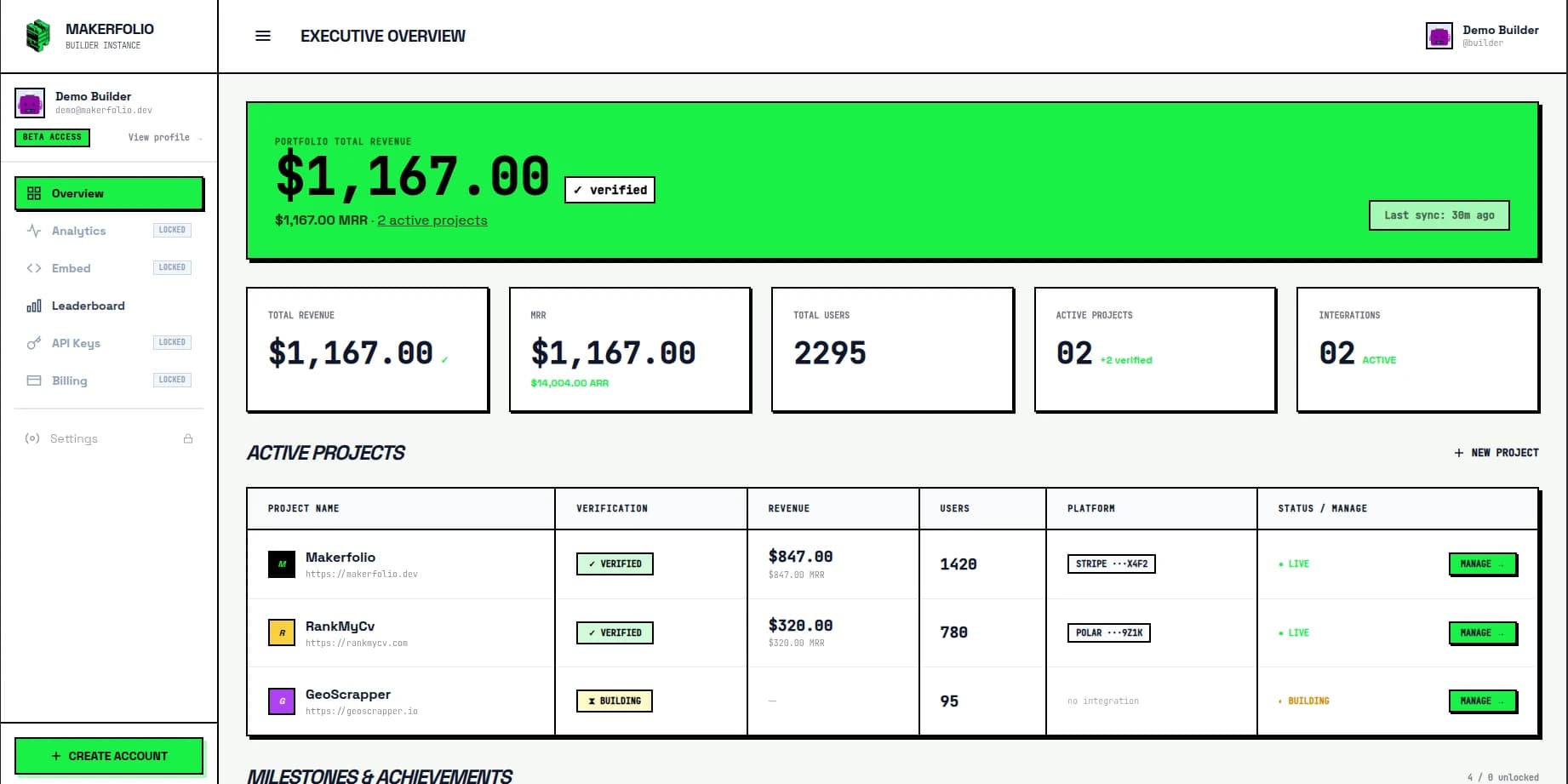
Verified MRR
$4.2k
Products
3 live
Processors
2
Who this dashboard is for
You post build-in-public updates on X every week but copy the same screenshot from last month because generating a new one is too much friction.
You want a permanent, linkable URL that proves your MRR without giving anyone read access to your Stripe or Polar account.
You build multiple products and need all of them visible on one profile instead of scattered across disconnected launch threads.
You want your revenue proof to travel with you as a reusable trust asset — not live and die in a camera roll.
You care about transparency but not at the cost of exposing customer emails, billing history, or invoice amounts.
You use Stripe, Polar, Lemon Squeezy, or a combination of all three and need one number that aggregates them correctly.
What a build in public dashboard actually needs to do
The phrase build in public has become both a genuine strategy and a performance. The difference shows up at the level of the number. When a founder consistently shares a verified, linkable metric backed by real billing data, the audience engagement compounds over time. When a founder shares a screenshot that says “we hit $10k MRR” with no source and no context, the post might get likes for a day, but it adds nothing to their long-term credibility.
Research published on Indie Hackers studying 56 businesses that hit $250k in revenue found that founders who tapped into communities and media through transparent reporting reached that milestone in 1.8 years on average — versus 2.9 years for those who relied on individual relationships alone. The channel that works is consistent, verifiable public reporting. Not launch announcements. Not product screenshots.
That consistency is what a build-in-public dashboard is designed to enable. The goal is not to give you one more chart to screenshot. It is to give you a permanent URL where the numbers update automatically and the source of truth is your actual billing API — not your memory of what the processor dashboard said three weeks ago. That URL is the asset. The tweet is just distribution for the asset.
There is also a privacy argument that blocks most founders from sharing revenue publicly in the first place. Sharing a Stripe dashboard screenshot is not actually safe — it can leak subscription counts, customer emails in payment metadata, plan names, or other operational signals you did not intend to expose. A proper build-in-public dashboard exposes only what you choose: aggregate MRR, product names, total active users. It never surfaces customer identity, individual invoice amounts, or billing history. Stripe's own API key guidance recommends restricted, read-only keys precisely because limiting access scope reduces exposure risk.
The multi-processor reality makes this even more relevant. A typical indie hacker in 2026 runs a SaaS on Stripe, sells a template pack or developer tool onPolar, and keeps a course or digital download onLemon Squeezy. Each processor reports revenue differently. A screenshot from one tells a partial story. The build-in-public dashboard that matters is the one that aggregates all three into one verified number and publishes it without manual work every month. That is exactly what apublic builder profileis designed to be.
Screenshot vs thread vs verified dashboard
Not all build-in-public formats carry the same weight. Here is how the three most common approaches stack up on the dimensions that actually affect audience trust.
| Capability | Screenshot on X | Thread / Notion update | Verified dashboard |
|---|---|---|---|
| Revenue proof type | None or self-reported claim | Screenshot — impossible to verify | Verified via billing integration |
| Lives without manual updates | No — must be refreshed by hand | No — thread-by-thread posts | Yes — syncs automatically on data refresh |
| Multi-product view | Hard to maintain across products | Thread-by-thread, no aggregation | All products aggregated on one profile |
| Permanent linkable URL | Sort of — scattered links | No — buried in timelines | Yes — permanent, shareable, always current |
| Customer privacy | N/A | Low — raw data visible in screenshots | High — aggregate metrics only, no customer data |
| Trust signal strength | Low — anyone can claim anything | Medium at best | High — backed by actual billing API data |
| Cross-processor support | None | None | Stripe + Polar + Lemon Squeezy |
How it works
Step 01
Connect your billing stack
Link Stripe, Polar, or Lemon Squeezy using read-only API keys. Makerfolio never requests payout access, customer data, or write permissions. You control what gets connected.
Step 02
Track MRR privately
See recurring revenue separated from one-time sales, normalized across billing intervals, and broken down by product and processor — before anything becomes public.
Step 03
Publish your public profile
Turn verified metrics into a permanent build-in-public URL. Share it in your X bio, launch threads, Product Hunt profile, or anywhere else you tell your story. One link, real proof.
Verified citations
Stripe Indie Founder Report 2024
“44% of profitable SaaS products are now run by a single founder — a figure that has doubled since 2018.”Open source ↗
Indie Hackers — What I Learned from 56 $250k+ Businesses
“Founders who found ways to tap into existing communities and media outlets reached $250k in revenue in 1.8 years on average versus 2.9 years for those building through individual relationships alone.”Open source ↗
Stripe Docs — API Keys
“Stripe API keys can be restricted to read-only access on specific resources, limiting exposure without removing visibility.”Open source ↗
Related pages
Public Builder Profile
The permanent proof URL that your build-in-public dashboard produces.
MRR Tracker for Indie Hackers
Track the recurring revenue number before you publish it publicly.
Revenue Dashboard for Indie Hackers
The private command center behind your public build-in-public profile.
Stripe and Polar Revenue Dashboard
See the exact processor integrations Makerfolio supports today.
Multi-Product Revenue Dashboard
Aggregate revenue across multiple products and payment sources.
Build in Public — Glossary
The concept behind transparent builder distribution, defined.
Sources
Publish your first build-in-public update with real numbers
Create a free Makerfolio account, connect Stripe or Polar, and get a verified public profile you can link anywhere. No screenshots, no manual updates, no privacy trade-offs.