
Best public builder profile
for indie hackers
If you build in public, a screenshot is not enough. The strongest profile for an indie hacker shows projects, verified recurring revenue, and clean proof without exposing customer data.
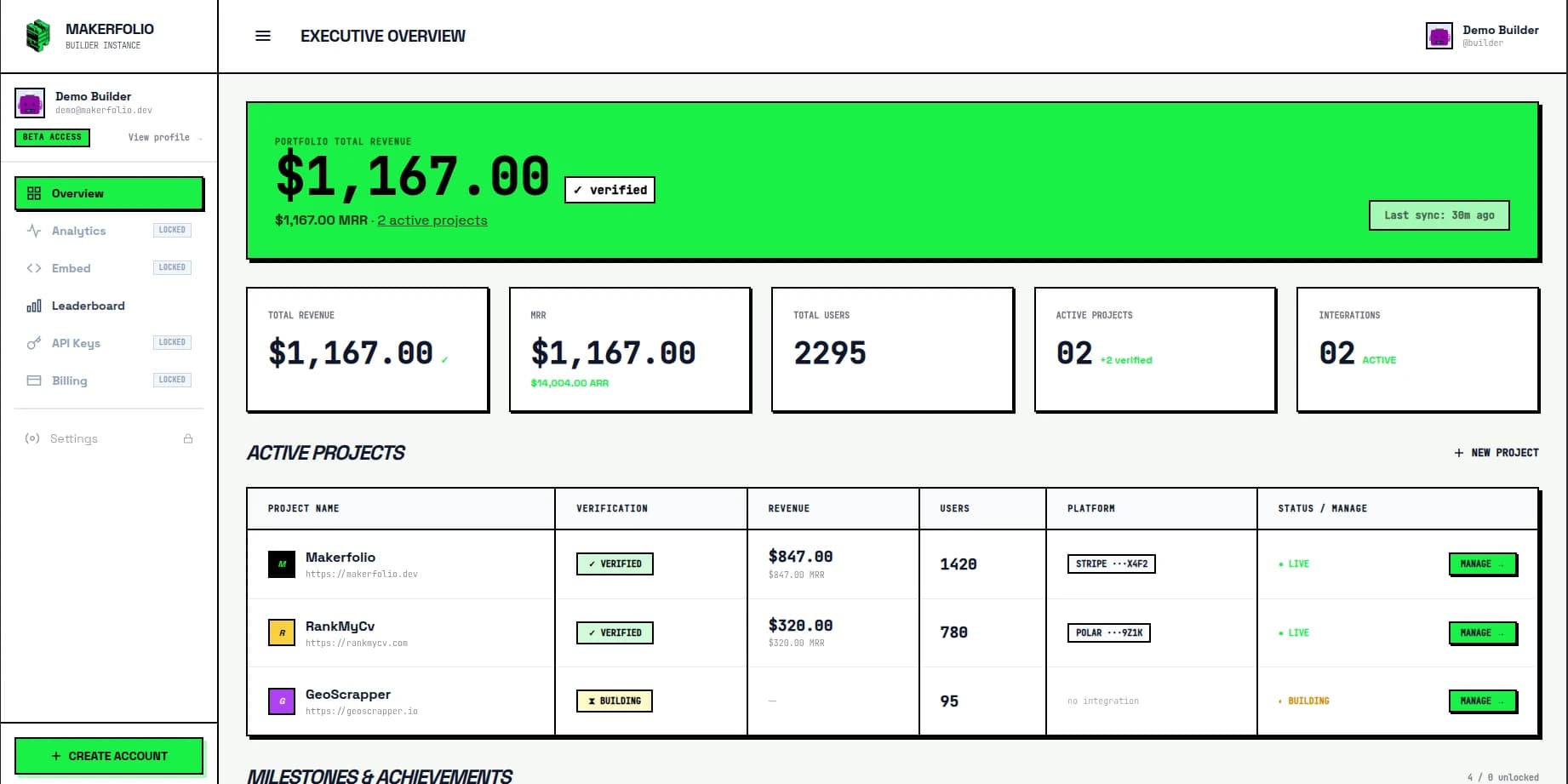
What actually works for public proof?
Most founders start with screenshots or a personal Notion page. That is fine for a week. It is not a durable trust asset. If you want something you can reuse across social posts, launch announcements, and landing pages, you need a public builder profile built for proof.
| Capability | Screenshot | Notion / static page | Verified profile |
|---|---|---|---|
| Verified recurring revenue | Manual claim | Manual claim | Verified via integrations |
| Project showcase | Weak | Strong | Strong |
| Trust for build in public | Medium | Low | High |
| Customer privacy safety | Low to medium | High | High |
| Reusable link for social proof | Low | Medium | High |
| Good for multi-product builders | Low | Medium | High |
Why verified public profiles win
Proof beats screenshots
A screenshot can be cropped, edited, or cherry-picked. A public builder profile turns revenue proof into a permanent URL with context around the project, the product, and the data source.
Privacy stays intact
The right public profile shows aggregate metrics like verified MRR, not customer emails, invoices, or billing history. That gives founders trust without leaking operational data.
One URL for your whole builder identity
Indie hackers do not just need a dashboard. They need a proof layer they can link from X, launch threads, personal sites, and investor intros without rewriting the same story every time.
What an indie hacker actually needs from a public profile
A normal portfolio page is about taste. A builder profile is about evidence. Indie hackers are not only trying to show what they designed. They are trying to show what they shipped, what people use, and whether the product has commercial traction.
That is why a public builder profile works especially well for bootstrapped founders. It combines three things in one place: the product story, the project list, and the business proof. When those live in different places, trust gets diluted. You have one screenshot on X, one launch page, one random Notion changelog, and a Stripe screenshot sitting in a camera roll somewhere. It is chaos.
And if you are publishing revenue at all, you need to understand the metric underneath the flex. That is why pages like the [MRR glossary](/glossary/mrr) matter. A public profile is only as credible as the way you calculate recurring revenue. If the number mixes one-time sales, annual plans, and random launch cash, the profile looks polished but says nothing useful.
The better model is one canonical page that carries your reputation. A clean public URL can show your projects, your build-in-public posture, and your verified recurring revenue layer. That last part is the difference between a personal site and an actual proof asset.
This matters even more for multi-product builders. A lot of founders do not have just one app anymore. They have a SaaS, a template shop, maybe a small developer tool, maybe a digital download business. One profile should help explain the whole stack instead of forcing people to inspect disconnected revenue screenshots and guess which number is real.
If your stack spans multiple providers, the value goes up again. A screenshot from one processor tells a partial story. A verified builder profile connected to pages like [Stripe](/integrations/stripe), [Polar](/integrations/polar), or the upcoming [LemonSqueezy integration](/integrations/lemon-squeezy) gives you a stronger system for public reporting.
Best use cases
Add a verified proof block to your landing page
Link your profile in launch threads and build-in-public updates
Show one place for multiple products and payment sources
Separate recurring revenue from one-time digital product sales
Give partners and customers a cleaner trust signal than screenshots
Revenue proof stack
Build the reporting layer behind the profile
Revenue Dashboard for Indie Hackers
See how verified public proof gets stronger when your private reporting layer is clean first.
Stripe vs Lemon Squeezy for Indie Hackers
Compare the payment stacks founders use before they publish revenue or product proof.
How to Calculate Net MRR Across Stripe, Polar, and Lemon Squeezy
Use a better recurring revenue model before turning numbers into social proof.
Read next
Revenue dashboard for indie hackers
Connect the private dashboard behind the public profile
Stripe vs Lemon Squeezy
Compare the stacks founders use before publishing proof
Calculate net MRR across processors
Use one recurring revenue framework for a mixed stack
Share Stripe revenue publicly
How to publish proof without exposing customers
Calculate LemonSqueezy MRR
Separate one-time sales from recurring revenue
MRR glossary
Refresh the core recurring revenue definition
Build in Public glossary
The concept behind transparent builder distribution
Create your public builder profile
Start with a free Makerfolio account, connect Stripe, and turn scattered screenshots into a real proof layer. Better trust, cleaner sharing, less privacy risk.