
Stripe and Polar
revenue dashboard
If your revenue is split between Stripe and Polar, each processor tells only part of the story. One shows deep subscription infrastructure, the other is often where developers manage software sales and digital products. The operational problem is not choosing one winner. It is getting one trustworthy dashboard.
Why founders search this category
Because checking Stripe for subscriptions and Polar for the rest is tolerable for a week, not for an actual operating rhythm.
Stripe
Usually where founders want more billing control, more customization, and deeper subscription infrastructure.
Polar
A strong fit for developers selling software, subscriptions, and digital products with merchant-of-record support.
Makerfolio
The layer that helps you see both processors together instead of treating each dashboard as its own reality.
Why this dashboard category has real buying intent
This is not an academic query. People who search for a Stripe and Polar revenue dashboardare already feeling the operational pain of a split stack. They know both tools matter. What they do not have is one place to reconcile them.
Stripe's documentation makes the security side explicit: integrations should use restricted API keys when possible so the system only sees the resources it actually needs. That matters because the moment you unify revenue across processors, trust and permission boundaries become part of the product, not just a backend implementation detail.
Polar's own docs position the platform around software sales, subscriptions, and merchant-of-record support. That makes it especially relevant for indie hackers who sell a mix of subscriptions and digital products. But it also means the founder ends up with two dashboards optimized for two different jobs. The missing layer is the reporting system that compares them side by side.
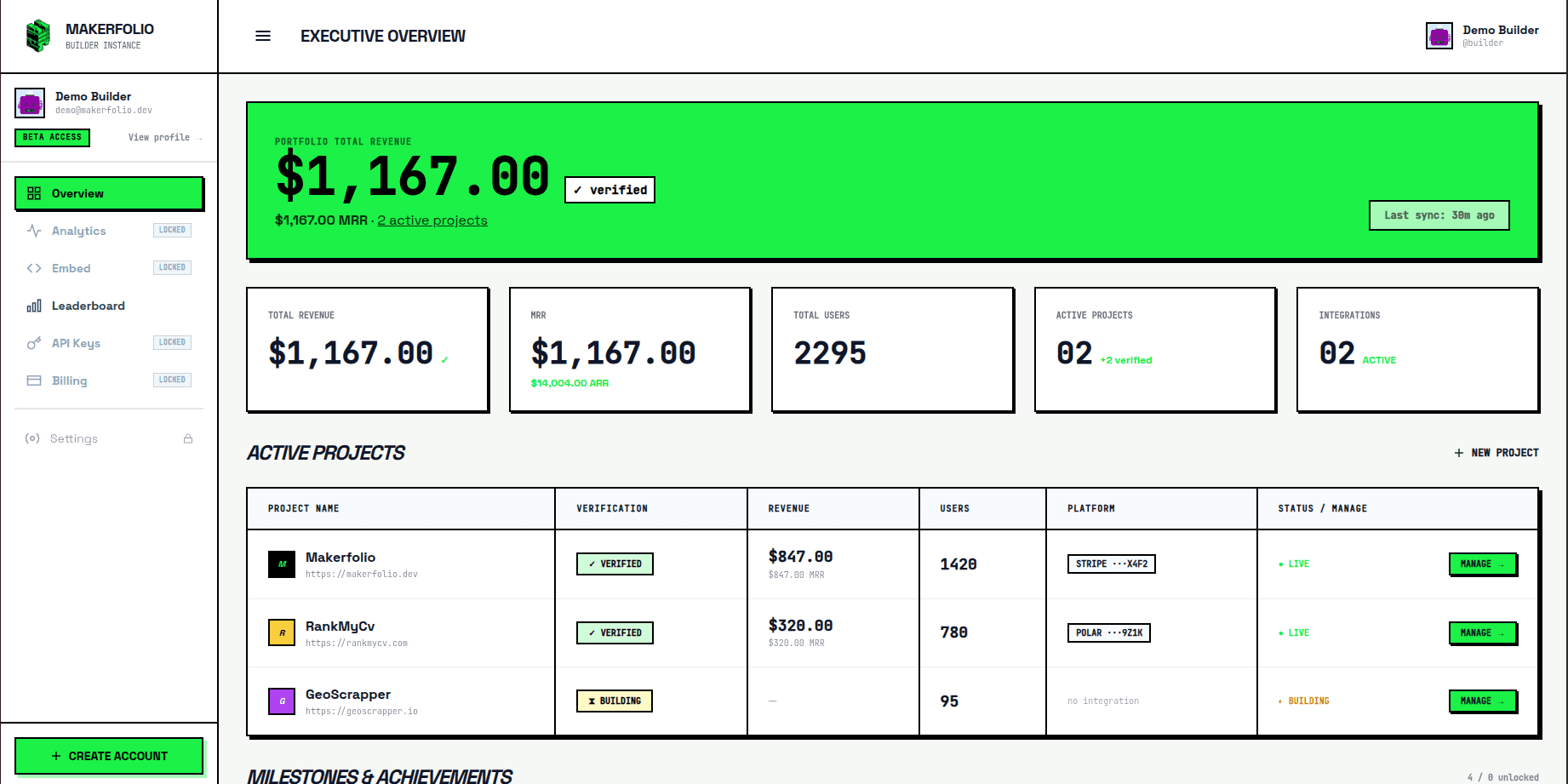
Makerfolio is designed for exactly that gap. It lets founders connect both platforms, keep a processor-level view, aggregate to a single verified total, and then decide whether to keep the numbers private or expose the clean output through apublic builder profile.
What the dashboard needs to show
| Layer | Why it matters |
|---|---|
| Stripe subscription revenue | Track recurring billing, lifecycle changes, and revenue tied to subscription behavior. |
| Polar subscriptions and orders | See recurring revenue and one-time product revenue without losing processor context. |
| Unified rollup | Compare the total business across two sources instead of trusting one dashboard headline. |
| Processor-level drilldown | Find which source is growing, shrinking, or carrying more of the business. |
| Verified sharing layer | Push a trusted number to a public builder profile after the private reporting is clean. |
Verified citations
Stripe Docs
“Use restricted API keys instead of secret keys when possible. Restricted keys limit access to only the specific API resources your integration needs.”Open source ↗
Polar Docs
“Sell digital products, subscriptions, and more without the hassle of traditional payment systems.”Open source ↗
Polar Docs
“As your Merchant of Record, we handle all international tax compliance.”Open source ↗
Related pages
Stripe integration
See the exact setup flow Makerfolio uses for Stripe.
Polar integration
See how Polar connection and revenue sync work today.
MRR Tracker for Indie Hackers
Start with the recurring revenue angle if your main problem is metric quality.
How to combine Stripe and Polar revenue
Support article on how to aggregate both processors without mangling MRR.
Multi-Product Revenue Dashboard
Move up one level if your problem is fragmented reporting across projects.
Stripe vs Polar for indie hackers
Compare the processors before deciding how your stack should look.
Public builder profile
Turn clean private numbers into something you can publish.
Sources
Run one dashboard instead of two tabs and a spreadsheet
Create a Makerfolio account, connect Stripe and Polar with read-only access, and get one operating view for recurring revenue, one-time sales, and public proof.